$PYGOD
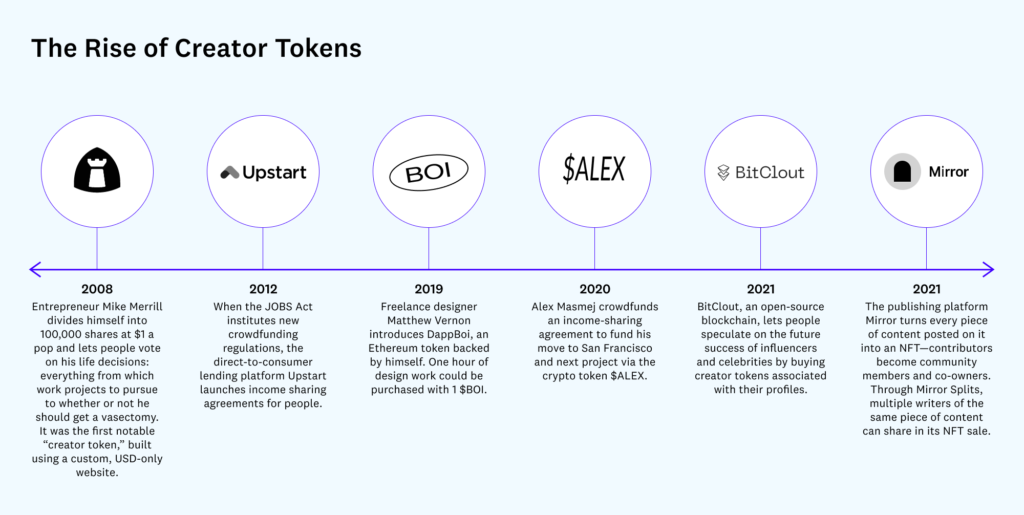
Divide yourself into 100,000 shares
$1 a share is equal to a net worth of $100,000.
Add a $ in front of your name, written in ALL CAPS, to be conceptually tokenized.
Net Worth Index
Net worth = Assets − Liabilities
Assets
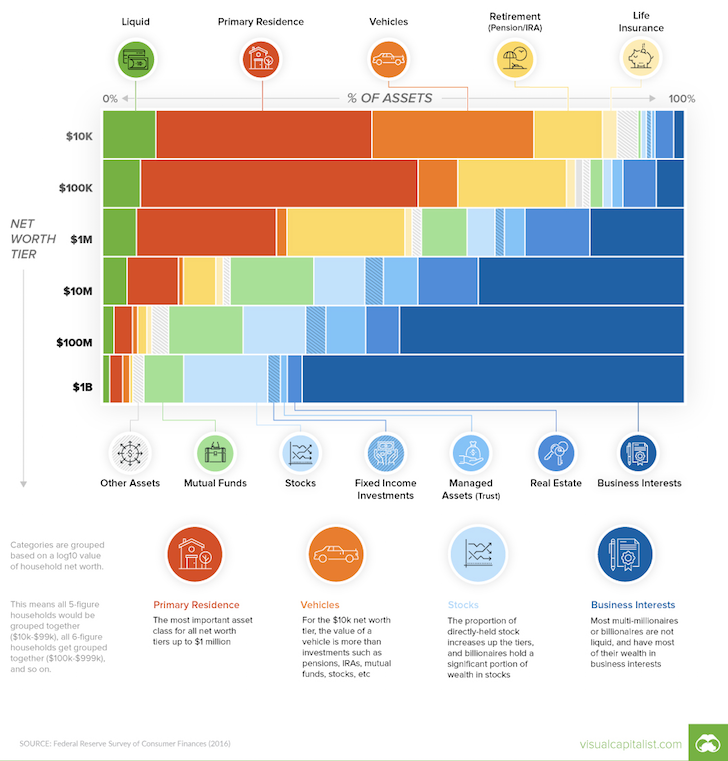
Business Interests
Valuation, not potential.
Investments
- Stocks
- ETFs
- REITs
- Bonds
- Mutual Funds
- Stock Options
- Forex
- Retirement accounts
- Cryptocurrency
- Precious Metals
- Cash-value life insurance (cash surrender value only)
- Managed Assets (trust)
- Real estate syndicates
- Other investment accounts
Real Estate
- Rental Properties
Homes
Residential Real Estate Value = Latest official municipal assessment
Municipal assessment is used not because it always represents the most accurate market value, but because it is objective, reproducible, independently determined, and readily verifiable.
Cars, Motorcycles & Boats
Vehicle Value = Current estimated wholesale/trade-in value
To answer the question: What could I reasonably sell this asset for today?
Cash
Paper money and loose change in your pocket, wallet, safe, piggy bank, or anywhere else you keep physical currency.
What is not an asset
- Your belongings – Clothes, furniture, computers, phones, gadgets, and other personal items you own. Basically, all the stuff you’ll get pennies on the dollar for if you sell it. If it’s something you actually use, keep it—replacing it later will probably cost you far more than what you’d get from selling it today.
- The money you loaned to someone – Without any legal paperwork, consider that money lost. Because, quite often, it is.
- Personal collections – Unless there’s a substantial, independently verifiable resale market. Don’t count what you think your collection is worth.
Liabilities
- Outstanding mortgage
- Outstanding vehicle, motorcycle & boat loans
- Personal loans
- Lines of credit
- Credit card balances
- Student loans
- Margin debt / investment loans
- Home equity lines of credit (HELOCs)
- Taxes owed
- Business debt personally owed or personally guaranteed
- Any other legally enforceable debt
Net Worth ÷ 100,000 = $YOU Share Price
YOU are a company with 100,000 shares outstanding. Your Net Worth represents your market capitalization, while dividing it by 100,000 produces your personal share price.
For example, if your net worth is $25,000:
$25,000 ÷ 100,000 = $0.25
If your net worth reaches $1 million:
$1,000,000 ÷ 100,000 = $10.00
If you’re in the red, then your share price is $0.00. No matter how deep in debt you are, your share price can’t go below zero.
Replace $YOU with your own ticker. In my case, $YOU becomes $PYGOD.
Then you can track your Net Worth chart month by month and watch your personal share price rise—or fall—over time.
You Are Your Net Worth

PYGOD, CFMI of $PYGOD
References:
https://www.mike-merrill.com/
https://kmikeym.com/
https://www.kickstarter.com/projects/kmikeym/publicly-traded-privately-held
https://www.wired.com/2013/03/ipo-man/
https://www.bitcoininsider.org/article/54686/community-and-capitalism-publicly-traded-person
https://medium.com/fitzner-blockchain-consulting/tokenizing-human-capital-f6a0c9f2b47a
https://a16zcrypto.com/posts/article/creator-tokens-and-community-tokens/
https://www.afr.com/technology/the-next-big-thing-in-crypto-is-a-little-piece-of-you-20211207-p59fi1
https://docs.google.com/spreadsheets/d/1IBJRJrIeRYStgxvnBmLWsREMhSA483uvu-A_kK4cB9I/edit?gid=0#gid=0
https://www.financialsamurai.com/the-two-levels-of-rich/
https://budgetsaresexy.com/do-you-include-pensions-in-your-net-worth-how-about-art-insurance-homes-cats-baseball-cards/
https://michaelfoster26.medium.com/the-worlds-first-quadrillionaire-revealed-e1e69487c4b3
https://www.linkedin.com/posts/matthewkorn_i-dont-know-who-will-be-the-first-quadrillionaire-share-7471519102151405568-yIoT/
https://mattkropp.substack.com/p/the-quadrillionaire-that-isnt-coming
GODistan

The Physical Foundation of Independence.
GODistan represents the tangible assets and resources accumulated to reduce future living costs, increase self-sufficiency, and provide long-term physical security.
Direct Investment
Money is merely a tool—a medium of exchange. Its value lies in the freedom it gives its owner to make choices that would otherwise be unavailable.
Money provides access to the necessities of life: food, shelter, clothing, medical care, transportation, and security.
You can’t eat paper money. You can’t drink gold. And you can’t live inside Bitcoin.
Food, Home, Land, Medicine, and Supplies are tangible resources and direct investments in a better future. They provide the means to satisfy essential needs while reducing dependence on society and outside systems.
Stocks, Cryptocurrency, Precious Metals, and other financial assets are indirect investments. They preserve or increase buying power that can ultimately be exchanged for the things you actually need.
Indirect investments increase your buying power. Direct investments decrease your dependence on buying.
Supply
Non-perishable food, clothing, supplements, toileteries, medicine and all the other things you need.
Have basic first-aid products on hand such as alcohol, Band-Aids, first-aid creams, burn gel, aspirin, a suture kit, eyewash, wraps,
Always good to buy in advance since prices will always go up.
I currently buy all my supplies and supplements on a quarterly or yearly basis. But my dream is to have a room dedicated to nothing but supplies for the next decade, I want a costco in my home.
When something you will inevitably consume can be bought substantially below its normal price and safely stored, buying tomorrow’s necessities today can provide a greater practical return than leaving the same MONEY earning a few percent.
Food Supply
Food, water, and shelter are among the most fundamental forms of wealth because they satisfy needs that MONEY itself cannot.
Against conventional wisdom, I include part of my food supply—primarily oatmeal and protein powder—in my Net Worth calculation.
For me, these supplies represent one of the most practical direct investments I can make.
Reasons:
- Food prices tend to rise over time. Buying non-perishable staples in advance can protect part of my future consumption from inflation.
- I replenish when prices are favorable. Sales and bulk purchases allow me to acquire supplies for less than I would otherwise pay.
- I know I will use them. Oatmeal and protein powder are staples of my daily diet. Unlike something purchased speculatively, these reserves have a predictable future use.
The objective isn’t to speculate on food prices. It is to buy something I know I will need, at a good price, before I need it.
MONEY buys food. Stored food has already done the buying.
Homeownership & Land

“Your Home is a Great Real Estate Investment.” – FixWillpower
“He said, ‘Son, stocks may rise and fall, utilities and transportation systems may collapse, people are no damn good, but they will always need land, and they will pay through the nose to get it. Remember,’ my father said…” – Lex Luthor, Superman the Movie
Really expensive but stable and usable compared to other assets.
You buy something that goes up in value.
You buy something that saves you money.
You have to live somewhere.
Unless you want to live under a bridge, you need a place to live.
Whether you rent or own it, shelter is one of life’s unavoidable expenses. The question is not whether you will pay for housing, but how you choose to secure it.
There is no universal agreement that owning a home is financially superior to renting.
Some financial experts strongly favor homeownership and the long-term security of eventually owning a paid-off home. Others argue that renting can be financially superior when the savings are invested, particularly after accounting for mortgage interest, property taxes, insurance, maintenance, transaction costs, and the opportunity cost of capital tied up in a house.
Both sides have a point.
Ultimately, I think the question can be answered by a much simpler rule:
“Don’t buy things you cannot afford, won’t actually use and that could cause you more pain than pleasure.”
— Barry Ritholtz
A home should increase your independence, not become a financial burden.
One Home
If I am going to own a home, the objective is simple:
Buy one good home and keep it.
There are two easy ways to turn homeownership into a financial liability: owning a succession of different homes throughout your life, or owning several homes at the same time.
1- The Serial House Trap
Buying and selling real estate is expensive. Realtor commissions, financing costs, inspections, legal fees, moving expenses, renovations, repairs, furnishings, and other transaction costs can consume a significant portion of a property’s value.
Repeatedly upgrading to a bigger or more expensive home also creates lifestyle inflation. More MONEY continually gets converted into housing instead of productive or income-generating assets.
GODistan should therefore be acquired with permanence in mind.
Don’t buy a starter home if you already know you won’t want to stay there. Don’t continually upgrade simply because you can afford to.
Buy the home you actually want when you can actually afford it—and, ideally, keep it for life.
2- The Parallel House Trap
A second home doesn’t merely mean owning another asset. It can mean another set of property taxes, insurance, utilities, maintenance, repairs, furnishings, security, and other carrying costs.
A vacation home should therefore not automatically be considered an investment. Unless it genuinely operates as a profitable investment property, it is primarily consumption.
There is nothing inherently wrong with buying luxuries when you can afford them. The mistake is pretending consumption is investment.
For GODistan, one home is enough.
If I want to spend time somewhere else, I can rent a hotel, cottage, apartment, or vacation home temporarily without assuming another permanent financial obligation.
Instead of accumulating a primary residence, cottage, vacation property, and whatever else as my wealth grows, I would rather concentrate those resources into one exceptionally useful permanent home—my Xanadu/homestead hybrid—while keeping the rest of my capital working elsewhere.
One Home. One GODistan.
Renewable energies
Worth paying once to never have to pay again and live “free”.
Prepping
Building Your Xanadu
Here, on the deserts of the Gulf Coast, a private mountain was commissioned and successfully built. One hundred thousand trees, twenty thousand tons of marble are the ingredients of Xanadu’s mountain.
Contents of Xanadu’s palace: paintings, pictures, statues, the very stones of many another palace — a collection of everything so big it can never be cataloged or appraised; enough for ten museums; the loot of the world.
Xanadu’s livestock: the fowl of the air, the fish of the sea, the beast of the field and jungle. Two of each; the biggest private zoo since Noah.
Like the Pharaohs, Xanadu’s landlord leaves many stones to mark his grave. Since the Pyramids, Xanadu is the costliest monument a man has built to himself.
A cautionary tale..
PYGOD, King of GODistan
References:
https://fixwillpower.com/blog/personal-emergency-funds/
https://fixwillpower.com/blog/home-real-estate-investment/
https://www.whitecoatinvestor.com/one-house-one-spouse-one-job/
https://www.looniedoctor.ca/2026/03/06/rent-vs-buy-home/
https://www.looniedoctor.ca/2018/06/22/physician-too-much-house/
https://www.looniedoctor.ca/2019/10/04/diy-home-maintenance/
https://www.looniedoctor.ca/2018/11/24/mortgage-income-splitting-canada/
https://techcrunch.com/2012/03/24/entrepreneurs-should-not-buy-homes/
How to get rich fast using the 40% rule | Grant Cardone
Food, Ammo, Land, Gold, Bitcoin or Stocks?
https://rethinksurvival.com/where-should-preppers-invest-money-in-2022/
https://survivaldispatch.com/money-shtf-prepping/
https://bcbusiness.ca/money/finance/2021-investment-guide-how-to-survive-the-financial-apocalypse/
https://www.self-reliance.com/2015/12/practical-prepping/
https://theprepared.com/prepping-basics/guides/emergency-preparedness-checklist-prepping-beginners#foundation
https://www.reddit.com/r/preppers/comments/znep5u/food_was_a_good_investment/
The One-Man MegaCorp
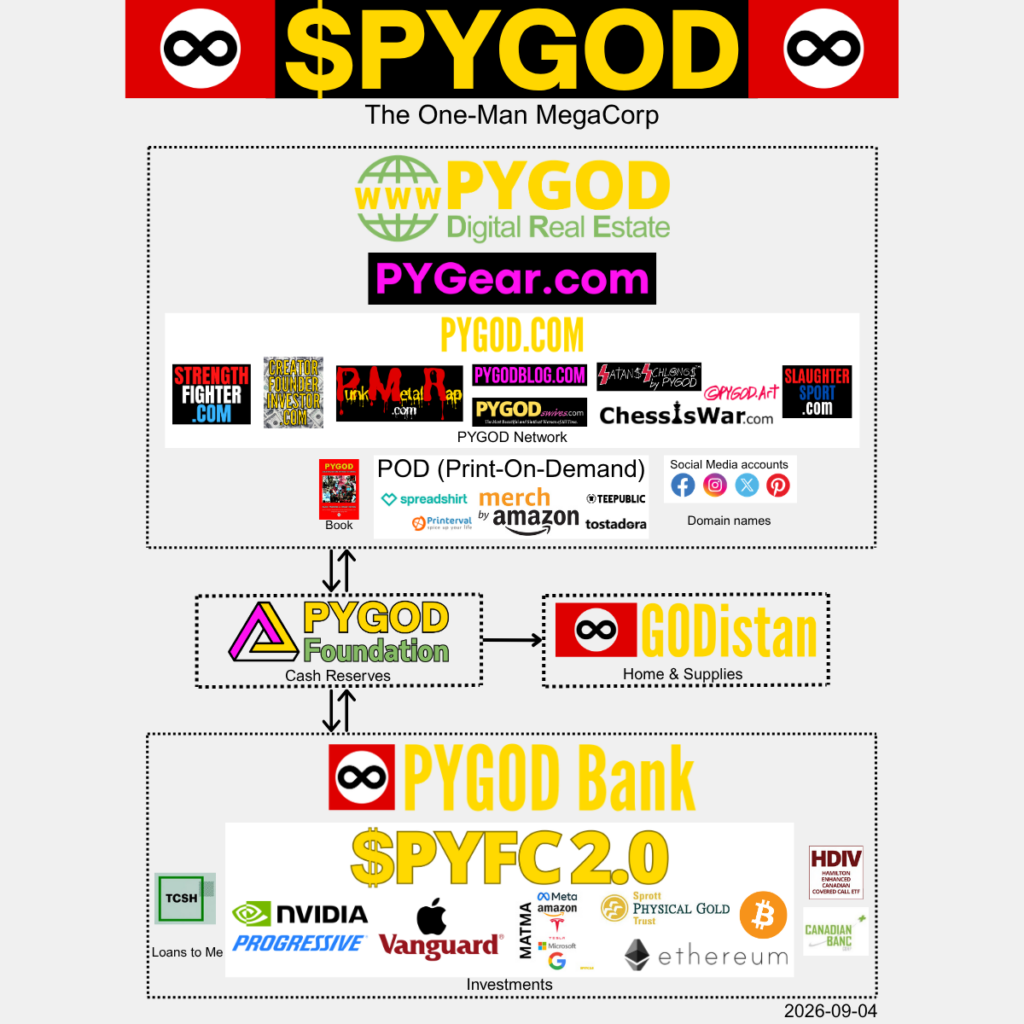
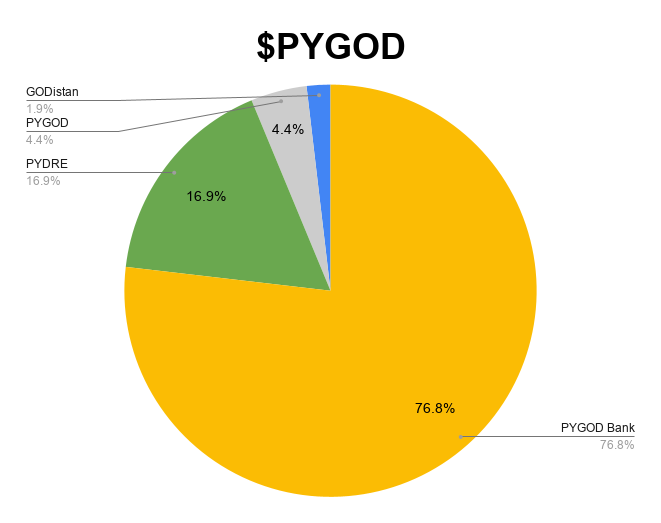
PYGOD Bank + PYDRE + PYGOD Foundation + GODistan = $PYGOD
PYDRE = Owned or Rented Digital Assets
PYGOD Bank = Invested Assets
PYGOD Foundation (War Chest) = Liquid Assets for Living Expenses & Reserves
“Owned or Rented” for PYDRE because websites/domains may be owned, while social media accounts, marketplace accounts, and platforms are effectively operated on infrastructure you don’t own.
PYDRE, the War Chest, and PYGOD Bank are three separate but interconnected entities within $PYGOD.
Each has its own job:
Making MONEY > PYDRE
Fully Self-Sufficient — PYDRE should generate enough income to cover its operating expenses and the founder’s living expenses without outside funding.
Having MONEY > PYGOD Foundation
The War Chest should be large enough to cover 6 to 12 months of living expenses.
Keeping MONEY > PYGOD Bank
PYGOD Bank should be large enough to live off its 3% annual dividend, if needed.
Capital can flow between all three, but their assets, rules, objectives, and accounting remain separate.
$PYGOD is the whole; the three entities are the machinery inside it.
MISSION
Build a self-sustaining financial machine that creates, preserves, and compounds wealth.
VISION
Be a One-Man MegaCorp capable of operating indefinitely and achieving complete financial independence.
SLOGAN
Making MONEY. Having MONEY. Keeping MONEY.
$PYGOD Strategy
- Sell T-shirts
- Acquire and hold stocks
Net Worth. Market Capitalization. GDP.
If you are going to run your financial life like a corporation, you need a way to measure both what you are worth and what you produce.
Net Worth
For an individual, net worth measures assets minus liabilities.
Market Capitalization
For a public company, market capitalization (market cap) represents the total market value of all its outstanding shares. It is calculated by multiplying the current share price by the number of shares outstanding.
GDP (Gross Domestic Product)
For a country, GDP measures economic output over a specific period of time—the total value of final goods and services produced within the country, usually over a year.
Within the $YOU framework, these concepts are adapted to measure wealth and productive output separately.
Your Net Worth = Your Market Capitalization
Your net worth represents the total value of the enterprise—you.
In my case:
$PYGOD Market Cap = PYDRE + War Chest + PYB
With 100,000 conceptual shares outstanding:
$YOU Share Price = Net Worth ÷ 100,000
The Share Price therefore rises or falls with the value of your accumulated assets and liabilities.
Your Personal GDP = What You Produce
Personal GDP measures the income generated by your productive economic activity, excluding income generated purely by accumulated financial capital.
Personal GDP = Business Net Profit + Employment Income + Service Income
In my case:
$PYGOD GDP = PYDRE Net Profit
PYDRE Net Profit represents the economic output generated by my businesses and digital assets after operating expenses.
Investment returns generated within PYGOD Bank—including dividends, interest, realized gains and unrealized gains—are not included in $PYGOD GDP. They belong to the capital side of the system and are reflected in PYB NAV and, ultimately, $PYGOD Market Cap.
Gifts, inheritances, asset appreciation, transfers between accounts, loans and other non-productive inflows are also excluded from Personal GDP.
In simple terms:
Your GDP is what you produce. Your Net Worth is your Market Cap.
$YOU Token — One Day of Production
Personal GDP can also be expressed as the value of one day of demonstrated economic output:
$YOU Token Price = TTM Personal GDP ÷ 365
In my case:
$PYGOD Token Price = TTM $PYGOD GDP ÷ 365
The Token is repriced monthly using the most recent trailing 12 months of actual economic output. It contains no forecast, future-income assumption, or speculative valuation.
If nothing is produced, Personal GDP is $0 and the Token is worth $0.00.
PYGOD Bank Contribution
Every dollar of $PYGOD GDP is subject to the PYGOD Bank contribution. A predetermined portion of the productive income generated by PYDRE ultimately flows into PYGOD Bank, where it becomes accumulated capital.
Tokenize Your Productivity

Your $YOU Token puts a value on your demonstrated economic productivity—both active and passive.
Unlike your $YOU Share Price, which represents accumulated Net Worth, the Token represents the income-producing power of your economic machine based entirely on what it has already produced.
Active Income
Income that primarily requires your ongoing time or labor:
- Employment income
- Freelance and service income
- Owner-operated business profits
Passive Income
Income generated by assets, intellectual property, or systems that can continue producing without requiring an equivalent amount of ongoing labor:
- POD royalties
- Music and other intellectual-property royalties
- Advertising and affiliate income
- Licensing income
- Profits generated by sufficiently automated digital businesses
Both count toward Personal GDP because both represent economic production.
Investment returns generated inside $YOU Bank are excluded. The Token measures the productivity of your income-producing engine, not the returns generated by accumulated financial wealth.
$YOU Token
The Token converts the last 12 months of production into a simple daily value:
$YOU Token = Personal GDP (TTM) ÷ 365
Trailing Twelve Months (TTM) — the total results generated during the most recent 12 months, continuously updated each month.
If your Personal GDP for the last 12 months was $36,500:
$YOU Token = $100.00
In other words, your economic machine produced an average of $100 per day over the trailing 12 months.
The Token is recalculated monthly as the trailing 12-month period changes. There are no projections, promises, or assumptions about future income. It represents demonstrated production only.
In my case:
$PYGOD Token = $PYGOD GDP (TTM) ÷ 365
Your Share tokenizes what you’ve accumulated. Your Token tokenizes what you produce.
The 20% Rule
The goal is to live on no more than 20% of your income.
The objective is not to reduce your standard of living until it fits within 20%. The objective is to increase your income until your existing standard of living, including your mortgage if applicable, represents 20% or less of what you make.
Don’t shrink your life. Grow your income.
This means that for every dollar required to support your lifestyle, the ultimate goal is to produce at least five.
In My Case:
The $PYGOD Token
My goal is to live on no more than 20% of the income represented by the $PYGOD Token ($PYGOD GDP).
“The most powerful tool for building wealth is income. Without income, you’re like a farmer without seeds or a farm.”
— Tommy Bryson
Once you reach the 20% goal, the remaining 80% of your income can be used to build wealth and financial security.
Following my principles, approximately 40% of your income will flow to your Bank through its established taxes and contributions.
If your War Chest already holds at least 6–12 months of living expenses, the remaining 40% can be used to pay off your home early, if applicable. Paying off your home early increases financial security while reducing future living expenses.
If you don’t have a mortgage, keep feeding your War Chest. There is no requirement to stop at 6–12 months—the larger your reserves, the greater your financial security.
The 20% Rule Leads to Freedom and Security
The ultimate objective is to have:
- A home you own, if applicable.
- Low living expenses.
- A substantial investment portfolio.
- A large financial reserve.
20% to live. 80% to build.
References:
How to get rich fast using the 40% rule | Grant Cardone
https://finance.yahoo.com/news/grant-cardone-swears-40-40-110053843.html
https://onestacapital.in/the-jewish-wealth-legacy-how-jewish-families-educate-kids-about-money/
https://petikspinayinvestor.files.wordpress.com/2015/05/the-money-jars-edition-3.pdf
https://www.harveker.com/blog/6-step-money-managing-system/
https://www.tigerhebert.com/post/2015/05/31/teach-kids-about-money-the-easy-way-with-the-3-jar-method
https://www.forbes.com/sites/learnvest/2014/04/21/why-i-tithe-and-so-should-you/?sh=7e1ecb4177a5
https://medium.com/@wealthymind1/simple-and-effective-money-management-system-63739295998c
Monthly Reporting
Unlike public companies, which generally report financial results quarterly, $PYGOD reports monthly.
Each monthly report tracks three headline indicators: Wealth, Production, and Survival.
1. $PYGOD Share Price — Wealth
Measures the accumulated value of the MegaCorp.
PYDRE Valuation — value of the income-generating businesses and digital assets, calculated according to the Digital Business Valuation formula.
PYB NAV — Net Asset Value of PYGOD Bank.
$PYGOD Market Cap — total Net Worth.
$PYGOD Share Price = Net Worth ÷ 100,000 Shares
The Share Price is recalculated monthly and contains no assumptions about future growth.
2. $PYGOD Token — Production
Measures the demonstrated economic output of the MegaCorp.
Monthly $PYGOD GDP — economic output generated during the month.
$PYGOD GDP (TTM) — total economic output generated during the most recent 12 months, updated monthly.
$PYGOD GDP = Average Monthly GDP of the Last 12 Months × 12
$PYGOD GDP includes PYDRE Net Profit, Employment Income, and Service Income. Investment returns generated within PYGOD Bank are excluded.
The TTM figure is the official $PYGOD GDP, while the monthly figure tracks current production.
The $PYGOD Token converts this annual economic output into the value of one day of demonstrated production:
$PYGOD Token Price = TTM $PYGOD GDP ÷ 365
One $PYGOD Token therefore represents one day of demonstrated economic output, based entirely on the previous 12 months. Its price is recalculated monthly and makes no assumptions about future income or growth.
| $PYGOD Share | $PYGOD Token | |
|---|---|---|
| Measures | Wealth | Production |
| Underlying | Net Worth | TTM GDP |
| Divisor | 100,000 shares | 365 days |
| Price changes | Monthly | Monthly |
| Forward assumptions | None | None |
$PYGOD Share → tokenized wealth
$PYGOD Token → tokenized productivity
3. War Chest Health — Survival
Measures how long the MegaCorp can sustain the founder without additional income.
War Chest — current value of the emergency reserve.
War Chest Health = War Chest ÷ Monthly Living Expenses
War Chest Health is expressed in months of living expenses covered, with a target of 6 to 12 months.
War Chest Health may fall below zero when living expenses are financed through debt. Negative War Chest Health represents the number of months of living expenses that must first be repaid before the War Chest returns to zero.
A negative War Chest is a mountain that must be climbed before rebuilding can even begin.
Monthly Commentary
A brief review of the month covering:
What Happened — major developments, wins, failures, unusual events, and the reasons behind significant changes in PYDRE, PYB, $PYGOD GDP, Net Worth, or War Chest Health.
Next Month — the most important problems to address, opportunities to pursue, and priorities for the coming month.
CORE TENETS / GOALS
FOCUS

ADAPTATION


ANTIFRAGILE

Create an unkillable machine.
PROFITS

$PYGOD History
July 11, 2005 — PYGOD reinvented himself as a self-taught blogger and webmaster.
2007 — PYGOD began designing and selling T-shirts online.
Over the years, PYGOD created and operated numerous websites and online ventures.
April 11, 2012 — PYGear.com went online as a blog created to promote T-shirt designs published on online marketplaces.
March 16, 2022 — $PYFC 2.0 was created with an investment in Bitcoin.
June 3, 2022 — $PYFC 2.0 began investing in the stock market.
July 26, 2022 — PYGear.com was transformed from a blog into an e-commerce business and blog.
September 9, 2022 — PYGear.com made its first e-commerce sale after 45 days, without paid advertising or a significant social media presence.
November 22, 2022 — The first PYGear Weekly Newsletter was published.
October 1, 2023 — PYGear.com became profitable after 14 months. Operating a self-hosted platform can be a major pain in the butt!
January, 2026 — Creation of $PYGOD Share.
August, 2026 — Creation of $PYGOD Token.
August 28, 2026 — $PYGOD is formally established as the One-Man MegaCorp, bringing PYDRE, PYGear, the War Chest, and PYGOD Bank into a single financial and business framework with the publication of the $PYGOD paper.
The Road Ahead
July 26, 2035 — The 13-Year Plan.
August 30, 2050 — 75 years young and Quadrillionaire!
PYGOD, CFMI of $PYGOD
Creator Founder Miser Investor
Creator
I need to create to live.
Founder
I need a business to make money.
Miser
I need to keep money to build wealth.
Investor
I need my money to make money.
References:
https://www.creatorfounderinvestor.com/adani-newbie-investors-investment-approach/
https://www.artofmanliness.com/character/advice/beyond-sissy-resilience-on-becoming-antifragile/
https://dariusforoux.com/one-thing/
https://iveybusinessjournal.com/publication/adapt-or-die/
https://davenemetz.com/founder-creator-investor/
https://marvinliao.medium.com/everyone-will-be-a-creator-a-business-and-an-investor-the-new-global-entrepreneurial-generation-4bb4eaf4c51a
https://www.linkedin.com/pulse/welcome-tices-society-tycoon-investor-creator-scholar-joshua-king/
https://michaelfoster26.medium.com/the-worlds-first-quadrillionaire-revealed-e1e69487c4b3
https://www.linkedin.com/posts/matthewkorn_i-dont-know-who-will-be-the-first-quadrillionaire-share-7471519102151405568-yIoT/
https://mattkropp.substack.com/p/the-quadrillionaire-that-isnt-coming
The Jewish Investment Strategy
Why Are So Many Jews Successful?
Jewish people represent only a tiny fraction of humanity, yet their representation among the world’s most successful entrepreneurs, investors, scientists, intellectuals, and other high achievers is remarkable.
In 2026, Forbes counted a record 3,428 billionaires worldwide, while Forbes Israel identified 319 Jewish billionaires—approximately 9.3% of the global billionaire population, despite Jewish people representing only about 0.2% of humanity. The list includes six of the fifteen richest people in the world, with fortunes behind some of the defining businesses of the modern era, including Google, Oracle, Meta, Dell, Microsoft, and many others.
This should not be interpreted to mean that Jewish people are inherently smarter, genetically superior, or fundamentally different from everyone else. They aren’t. Intelligence, ambition, creativity, and entrepreneurial ability are not the exclusive property of any religion or ethnic group.
A more interesting explanation lies in culture, education, history, and community.
Jewish tradition has placed enormous importance on education, literacy, study, debate, family, community, charity, commerce, and the responsible management of MONEY. These ideas have been transmitted from one generation to another for centuries.
History also matters. Jewish communities repeatedly faced persecution, expulsion, restrictions on land ownership, exclusion from occupations and guilds, and other forms of discrimination. Under different circumstances and in different places, this encouraged participation in occupations that were available and portable—including trade, commerce, lending, professional services, and eventually entrepreneurship and finance.
What began partly as adaptation to difficult circumstances helped create traditions and institutions that placed considerable value on education, enterprise, financial knowledge, and mutual support.
There is no secret Jewish gene for making MONEY.
There is, however, thousands of years of accumulated knowledge worth studying.
And you don’t have to be Jewish—or religious—to learn from it.
One particularly interesting financial principle appears in the Talmud:
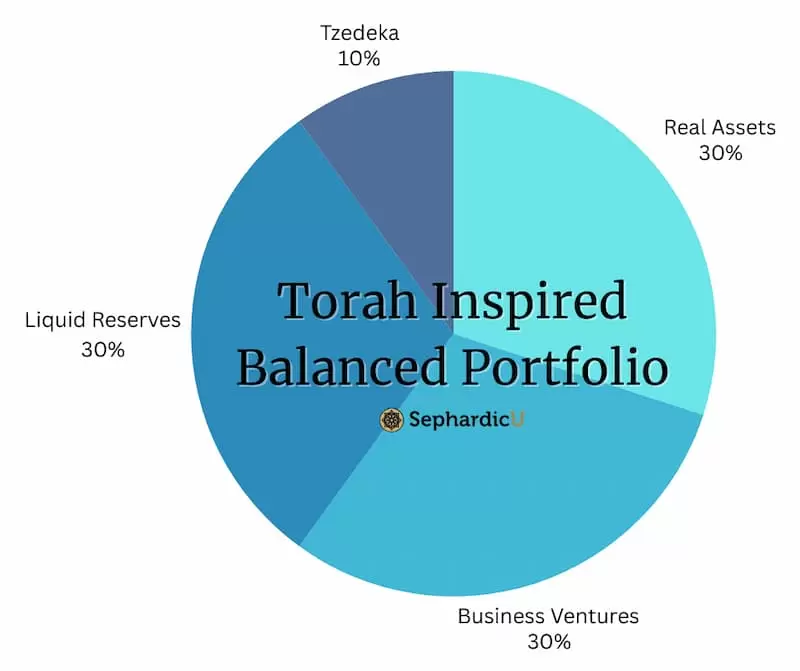
“Let every man divide his money into three parts, and invest a third in land, a third in business, and a third let him keep by him in reserve.”
— Talmud, Bava Metzia 42a
The Talmud say to keep a third of your money in cash, a third in business/inventory, and a third in land/real-estate.
This timeless statement advices the student to have what today is called a balanced portfolio.
In ancient times there was no stocks or bonds and for much of history no banks as we know them.
A person could have a goods business in a town, a farm or an inn, and of course a secret stash of gold/silver/copper coins in their own safe or secret hiding place.
Land was the place one lived and the farmaland to grow food. Stable, tangible assets.
Business meant tools to make the inventory or the goods themselves. Productive ventures.
Reserve meant to have a secret stash of coins in case the business failed or one had to flee or capitol to buy inventory. Liquid, accessible capital.
Overall, this was a remarkably resilient strategy. Land provided tangible wealth and productive capacity, business generated income, and reserves provided liquidity for emergencies, opportunities, or starting over.
Most people in ancient times had little surplus wealth. The Talmudic principle nevertheless emphasizes the importance of keeping part of whatever wealth one possesses in reserve.
In today’s key asset classes: real estate (land), equities and business ventures (merchandise), and cash reserves (liquid assets).
For the Jewish investor, tzedakah (the 10% tithe) is part of the portfolio. Just as one diversifies assets to build financial stability, one allocates resources to tzedakah to build spiritual integrity. In my case, I allocate my “Tithe to Yourself” directly to PYGOD Bank to build financial integrity.
Now applying these principle to $PYGOD
⅓ Land → GODistan
Home, land, supplies, physical independence.
⅓ Business → PYDRE
Productive enterprises generating MONEY.
⅓ Reserve → PYGOD Foundation
Liquid MONEY available when needed.
10% Tzedakah (Tithe) → PYGOD Bank
Permanent capital preserved and compounded for the future.
References:
https://sephardicu.com/torah/jewish-investing-principles-torah-based-guidelines-for-financial-success/
https://www.quora.com/Why-does-the-Talmud-say-to-keep-a-third-of-your-money-in-cash-a-third-in-business-inventory-and-a-third-in-land-real-estate
https://www.creatorfounderinvestor.com/the-money-code-become-millionaire-with-the-ancient-jewish-code/
https://www.creatorfounderinvestor.com/talmud-hotel/
https://www.creatorfounderinvestor.com/do-you-want-to-be-rich-think-like-a-jew/

(PYDRE) PYGOD Digital Real Estate
Stepping stone.
A company holding and operating a portfolio of digital assets (ecommerce, print-on-demand accounts, websites, domain names, social media accounts).
- Cash flow
- Passive income
Operated with minimal time, effort, and money, if any at all.
Digital Assets
- Websites
- Rank-and-rent websites
- Blogs
- eCommerce stores
- Dropshipping businesses
- SaaS (Software as a Service)
- Digital products (eBooks, courses, downloads, audiobooks, membership programs)
- Apps
- Domain names
- Email lists
- Newsletters
- Podcasts
- Online marketplace shops (Etsy, eBay, Amazon, etc.)
- Online communities and creator accounts (OnlyFans, Patreon, etc.)
- Print-on-Demand accounts (Merch by Amazon, RedBubble, Teepublic, etc.)
- YouTube channels
- Social media accounts
- Metaverse land and digital property
- Books and publishing rights
- Music and music rights
- IP (Intellectual Properties)
However, being classified as a Digital Asset does not automatically give it monetary value. To be valued, the asset must generate income. Until then, regardless of its traffic, followers, or potential, its valuation is $0.00.
The 40% Rule
Digital Business Valuation
A digital business is valued at 2.5× its annual net profit, equivalent to 30 months of average profit.
Average Monthly Net Profit (Last 12 Months) × 30 = Digital Business Valuation
The formula provides a simple, conservative, and consistent valuation based on actual profitability rather than hypothetical potential. Using the average monthly net profit of the last 12 months smooths short-term fluctuations, while the 30× multiple values the business at the equivalent of 2.5× annualized profit.
Now, I challenge you to find any investment—real estate, stocks, crypto, or otherwise—that can deliver a 40% annual return on investment on a regular basis.
POD (Print-On-Demand)

Licensing /Royalties / Passive Income Is The Sweetest MONEY You Can Get.
— PYGOD
My main, time-tested business is POD (Print-On-Demand): running online marketplace accounts that collect royalties from products sold with my designs on them.
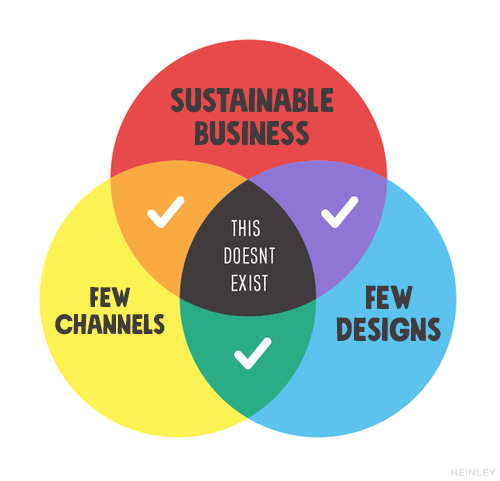
The 40% Rule:
Average Monthly Net Profits (last 12 months) × 30 = POD Account(s) Value
2.5 years of profit is the conservative value for a POD account. Which represents a 40% annual return on investment.
POD accounts are usually sold at a 40× multiple, so a 30× multiple is a very conservative estimate of what will actually remain in your pocket after broker fees and other transaction costs.
As I like to say: It’s the sweetest Money you can get.
- Passive Income
- Nothing to do
- No operating fees, usually
- No marketing
- No customer service
- No acquisition cost
- No inventory
All you have to do is a huge quantity of T-shirt designs to start your business. It’s a number game. A lot of repetitive work is required at the beginning, including designing, upscaling, and uploading. To make this business successful, you’ll need thousands of designs published on several online platforms. You’ll also need a lot of patience, since the results don’t come fast.
There are risks. Platforms can change their algorithms, reduce creators’ royalties, limit the number of designs you can publish, or even ban your account. Their house, their rules.
The next logical step is a business you fully own.
The Print-On-Demand (POD) marketplaces are the upfront, passive money while growing my main business, PYGE, is my priority.
Rocket Company

The rocket company principle of Kane Kallaway.
Where he articulates his long-term “vision” which is similar to my framework around my rocket, PYGear.com (PYGE) that I’m sending straight to the fuckin’ moon.
Once you have the launch pad built (audience) and a consistent fuel production (reliable cash source), you’ll be able to start launching rockets (businesses).
First, what does a rocket company do? It makes rockets, fuels them up, and launches them into space.
Here’s each component:
- 🏭 Rocket company = PYDRE (PYGOD Digital Real Estate)
- 🚀 Rockets = business, only one for me, PYGear.com
- ⛽️ Rocket fuel = cash (via savings, investments, cash-flowing assets, etc.) In my case, my War Chest and Print-On-Demand (POD) royalties.
- 🛣️ Launch pad = audience of potential customers. Leveraging social media and my websites.
Kane Lallaway’s ultimate goal is to build a company that can launch and grow multiple businesses (e.g., a hold co).
So to build a rocket company, there’s 3 places you can start:
- 🚀 Build the rockets: You could start by building the first business (rocket) without any cash or customers. Imo, this is the hardest place to start, because every business needs customers and if you don’t have them, you’ll need cash to acquire them. This is where I’ve started in the past. Didn’t work
- ⛽️ Make/earn the fuel: You could also start by accumulating cash (via savings, investments, cash-flowing assets, etc.). All rockets need fuel, so accumulating it before you starting making the rockets is logical. But I’ve tried this too. Took cash with no customers and tried to launch a business. What ends up happening is that you have a bunch of cash and no idea how to actually get customers, so you waste your cash building rockets with no pad to launch them from. A rocket full of fuel with no way to launch is just an expensive paperweight
- 🛣️ Build the launch pad: The third option is to start by building the launch pad. Rockets come in all shapes and sizes, but they all launch off the same platform (in my example). Build once, launch many. So while we’re going to also need fuel to launch any rocket, the launch pad is the most critical. Fuel can be easily bought or traded for. It’s much harder to buy an authentic launch pad (aka customer base). Launch pad = customers
The Creator Business Decision Tree (Kallaway Strategy)

Ideal Path (according to Kallaway)
-
Start by making content.
-
Use that content to grow an audience (publish on social media)
-
Automate some/all of the content creation process. Start thinking about it when you have a sizable audience of roughly 50K followers on a single platform
-
Create and sell an owned product/service to your audience. That’s where the big bucks are.
If you want to win big as a creator (and make a ton of money), this is the formula to do it.
Now I will blend these two Kallaway’s inspiring posts into one.
How to Build a 🏭 Rocket company
Hold Co aka Personal Holding Company
🛣️ Build the launch pad
Start by creating content and publishing it on social media to grow an audience of potential customers.
A lauch pad is sizable audience of roughly 50K followers on a single platform.
⛽️ Make/earn the fuel
Money. Doesn’t need any explanation.
But first, you need the lauch pad.
🚀 Build the rockets
Sell an owned product/service to your audience
The big money comes when you own a product/service and sell it to your audience with no/low CAC (Customer Acquisition Cost).
Think things like MrBeast’s Feastables, Logan Paul’s Prime, Divvy, Chamberlain Coffee, etc.
It’s really not worth thinking about this until you have a large enough audience to fund it or have automated enough to free up your time to work on it.
If you’re starting from scratches. Stocks, crypto, forex trading won’t make you rich. But your business (rocket) will if you succeed.
That’s the reason why this is the Crown Jewel of PYDRE.
🚀 PYGear.com is flying to the Moon!
References:
https://www.creatorfounderinvestor.com/personal-holding-company/
https://blueprint.game/p/blueprint007
https://blueprint.game/p/blueprint015

PYGear.com (PYGE)
PYGear.com is an e-commerce business.
- Store — sells products.
- Content — attracts customers.
- Email — reaches and retains customers.
- Social Media — distributes content and attracts customers.
- Operating Capital — funds day-to-day operations and growth.
Feel-Good Business (Lifestyle)
What would I do if I were a billionaire?
Today, my answer is:
Exactly the same thing.
CUSTOMER OBSESSION, our daily mission.

PYGear has one principle: Customer Obsession.
Strategies change. Technologies change. Platforms change. Business models change. What customers want changes.
Our job is to change with them.
PYGear.com exists to serve. Our job is simple: get customers, understand customers, and delight customers. Give them what they want—not what we want them to want.
That requires listening, experimenting, measuring, and adapting. What customers actually do matters more than what we assume they will do.
Data-driven means understanding what customers actually click, browse, and buy—and using that information to give them more of what they want. Best sellers aren’t merely successful products; they’re customers telling us what deserves more exposure.
Everything else is a tool.
AI is a tool. Automation is a tool. SEO is a tool. Social media is a tool. Advertising is a tool. Email is a tool. Marketplaces are tools. Solopreneurship is an organizational structure, not a restriction. Sovereignty is valuable when useful, but never an excuse to make the customer experience worse.
No tool, technology, platform, traffic source, or business model is sacred. The customer is.
Distribution
A great product that customers never discover might as well not exist.
Distribution means getting to customers by any means that makes sense.
PYGear should never depend unnecessarily on a single gatekeeper. Search engines change. Social networks change. Algorithms change. Advertising costs change. Platforms rise and disappear.
A resilient PYGear therefore builds multiple paths to the customer:
- Search — customers discover PYGear through Google and other search engines.
- Social — content puts PYGear in front of customers where they already spend their time.
- Paid — advertising can acquire customers when the economics make sense.
- Owned media — especially email, where PYGear can repeatedly reach an audience it has already earned.
The objective isn’t diversification for its own sake. The objective is reliable access to customers.
The same applies to revenue. Products, advertising, affiliate revenue, or entirely new opportunities can coexist when they serve customers and strengthen the business.
Customer Obsession Requires Profit
Customer Obsession = Profit.
Not because every customer interaction must immediately produce money, but because a business that perpetually loses money eventually loses its ability to serve anyone.
Profit allows PYGear to improve the store, create and discover products, acquire customers, experiment, invest in technology, survive mistakes, and continue operating.
We need to make profits if we want to continue serving our customers.
That creates a simple cycle:
Get customers → Delight customers → Learn from customers → Give them more of what they want → Make a profit → Reinvest → Reach and delight more customers.
And then do it again.
Whatever They Want It to Become
PYGear does not exist to defend a particular technology, platform, organizational structure, product category, or way of doing business.
Those things can—and should—change.
The principle does not.
PYGear.com exists to serve.
PYGear.com is whatever our customers want it to become.
PYGOD, Founder & CEO of PYGear.com
(Chief Everything Officer)
References:
https://www.creatorfounderinvestor.com/personal-holding-company/
https://blueprint.game/p/blueprint007
https://blueprint.game/p/blueprint015
https://blueprint.game/p/blueprint052
https://blueprint.game/p/blueprint012
https://latecheckout.substack.com/p/the-multipreneur-manifesto
https://latecheckout.substack.com/p/why-the-future-of-startups-are-studios
https://x.com/PersonalHoldCo
https://x.com/YongSooChung/status/1733336142945075291
https://twitter.com/YongSooChung/status/1699805138016419848
https://x.com/levelsio
https://www.firstclassfounders.com/
https://www.firstclassfounders.com/the-rise-of-personal-holding-companies-exploring-the-future-of-entrepreneurship/
https://twitter.com/itsDanny_V/status/1649778840569516032
https://x.com/bill_kerrrrr/status/1770434948488434132/photo/1
https://www.creatorfounderinvestor.com/artist-corporation/
The 40% Rule
https://jaserodley.com/entrepreneurial-investments/
https://jaserodley.com/selling-a-website-business/
https://fatstacksblog.com/other-peoples-money-to-grow-new-niche-websites/
https://onehourprofessor.com/digital-real-estate/
https://www.concreit.com/blog/digital-real-estate-investing
https://www.fatrank.com/what-is-a-digital-landlord/
https://www.fatrank.com/digital-real-estate/
Using Your SEO Agency Like Private Equity
Comment gagner ses premiers revenus avec les revenus passifs !
https://www.teepublic.com/blog/michael-essek-pick-two
https://nathanbarry.com/billion/
https://nathanbarry.com/wealth-creation/
https://creatorscience.com/skyscraper-or-strip-mall/
https://www.linkedin.com/pulse/skyscrapers-vs-strip-malls-jay-clouse/
https://x.com/mvarghese5/status/1513503198295863298
https://creatorscience.com/signature-product/
https://youtu.be/qHDAKevRrvw?si=NzROxgtsoSBupY21
https://medium.com/@gabemarken/traba-the-next-trillion-dollar-company-6886db42616d
https://traba.work/blog/we-are-traba-the-future-of-work-is-here
https://searchengineland.com/billion-dollar-one-person-seo-agency-445273
https://orbilontech.com/ai-automation-1b-one-person-company/
https://www.moneyandfinancemagazine.com/sabri-suby-marketing-that-gives-you-a-license-to-print-money/
https://revolutionarylifestyledesign.com/big-business-can-lose-money-business-cant/
https://revolutionarylifestyledesign.com/how-to-start-a-business/
https://web.archive.org/web/20210116112259/https://www.productized.services/p/playbook
The Productized Playbook
https://kit.com/mission
https://yeys.com/2024-niche-site-model/
https://www.quora.com/What-if-Elon-Musk-focused-all-his-time-and-energy-into-Tesla
https://www.theverge.com/2020/12/23/22197823/elon-musk-tesla-spacex-x-boring-company-neuralink-holding-speculation
https://nypost.com/2022/04/22/x-holdings/
https://leegoldberg.com/you-are-a-billion-dollar-multi-national-publishing-conglomerate/
https://www.inverse.com/article/27790-christian-grey-billionaire-holding-company-fifty-shades-of-grey
https://megacorp.kairus.org/index.html
PYGOD Foundation (fka War Chest)

Mission: Insuring the survival of the Entreprise and its Founder.
- Profit is King (Valuation)
- Liquidity is Queen (War Chest)
War Chest Health = Months of Living Expenses Covered
The War Chest provides the liquidity required to pay the Founder’s living expenses while protecting the survival of both the Founder and the Enterprise.
It is not merely an emergency fund. It is the financial buffer between $PYGOD’s productive assets and the Founder’s everyday life.
War Chest Health
War Chest health is measured by:
Months of Living Expenses Covered
The objective is to maintain enough liquid reserves to fund 6 to 12 months of living expenses.
Money flows into the War Chest and living expenses flow out. Maintaining an adequate runway gives $PYGOD time to operate, invest, adapt, and recover without being forced to sell long-term assets or make decisions out of financial necessity.
Goal: 6–12 months of living expenses.
Liquidity Safety
Never keep the entire War Chest in one place.
Split liquid funds across at least four different financial accounts or institutions, including at least one traditional brick-and-mortar bank. Do not rely exclusively on online banks.
The objective is simple: no single bank, platform, account freeze, technical failure, or access problem should cut off the Founder from liquidity.
Just in case.
References:
https://blog.investingnote.com/how-do-you-prepare-a-growing-warchest-guest-post/
https://sephardicu.com/torah/jewish-investing-principles-torah-based-guidelines-for-financial-success/
https://www.quora.com/Why-does-the-Talmud-say-to-keep-a-third-of-your-money-in-cash-a-third-in-business-inventory-and-a-third-in-land-real-estate
∞ PYGOD Bank (PYB)

Wealth Building. Wealth Preservation. Financial Independence. Antifragile.
Don’t let the Infinity symbol and the name Bank fool you. This IS NOT a life insurance scam. You can Be Your Own Banker without buying a life insurance from a snake oil salesman. Why there is so much of these scammers publishing videos on YouTube and books on Amazon. It’s not because they want to keep you informed?! It’s because the commissions are extremely generous for the seller. 50-100% commission for the first year premium and 2-10% for years to come.
No, you won’t become a Billionaire by buying Life Insurance.
No, Life Insurance wasn’t a determining factor in the Rockefeller dynasty’s remaining fortune today.
- 99% of dynasty wealth came from Standard Oil
- Then from 140 years of holding blue-chip stocks and compounding did the rest.
- Whole Life Insurance returns are 1-4%.
Yes, the PYGOD Bank concept is inspired by the dynasty Family Bank like the Rockfellers, Rothschilds, etc.
However, unlike most Family Offices, I don’t need a bunch of full-time overpaid parasites (CFO, lawyers, accountants, etc) to run it.
Family Banks vs Companies
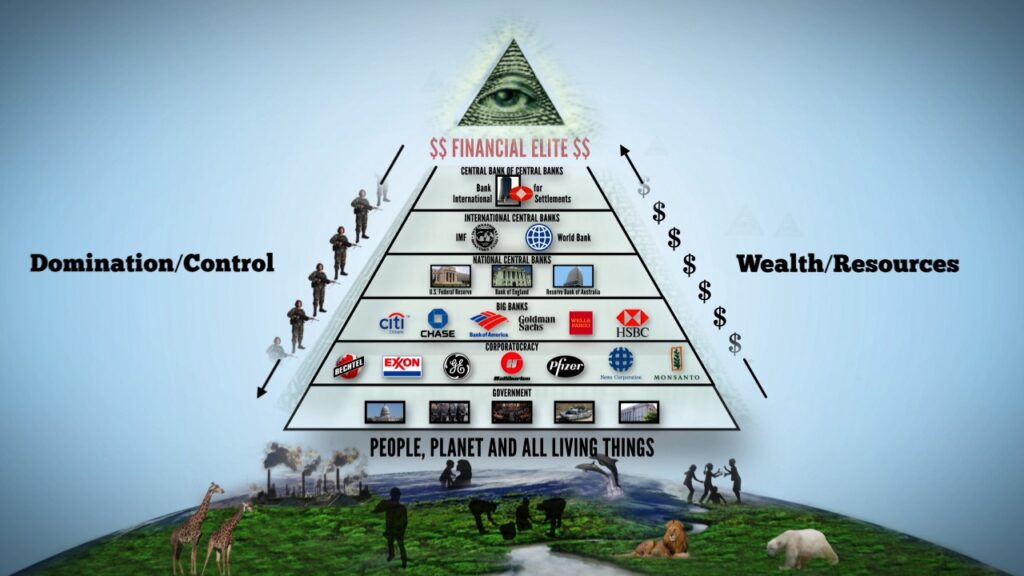
Rockefeller-style and Rothschild-style Family Banks are the strongest financial entities ever created.
And here’s why:
🦁 1. Companies Die. Family Banks Don’t.
Even the largest companies on Earth eventually get:
- disrupted
- outcompeted
- regulated
- replaced
- innovated around
- Examples:
- GE fell
- IBM fell
- Nokia fell
- BlackBerry fell
- Sears died
- Kodak died
- Oil giants fluctuate
- Even today’s stars (Meta, Google, Apple, Nvidia) could be disrupted someday. That’s the reason why $PYFC 2.0 is also invested in Gold and the broad S&P500 Index.
No corporation is immortal.
But a Family Bank?
- It doesn’t sell one product
- It doesn’t depend on a single market
- It doesn’t rely on innovation cycles
- It can change direction instantly
- It can own ANY asset class, anywhere
A family bank is not a business.
It is an architecture of wealth.
🏦 2. A family bank can survive ANY economic cycle
- Recessions
- Depressions
- Hyperinflation
- War
- Regime change
- Tech shifts
- Market crashes
- Industry death
Family banks survive because:
- They hold diversified assets
- They lend instead of consume
- They NEVER sell in panic
- They don’t have shareholders demanding returns
- They think in 100-year time frames
The Rothschilds survived:
- The fall of Napoleon
- The Crimean War
- World War I
- World War II
- The Great Depression
- Multiple fiat currency collapses
- Regime changes in Europe
No corporate entity has EVER survived that level of destruction.
But their family bank did.
💎 3. Family banks do not depend on external capital
Corporations require:
- customers
- innovation
- product-market fit
- revenue
- investor confidence
- access to credit
Family banks require:
- discipline
- capital preservation
- compounding
- internal lending
VERY different foundations.
A family bank cannot “fail” unless the family:
- destroys it
- empties it
- abandons discipline
It is antifragile by design.
🔥 4. A family bank can OWN companies, but companies cannot OWN a family bank
Rockefeller Family Bank → owned:
- Standard Oil
- real estate
- railroads
- banks
- oil pipelines
- global assets
- later tech stocks
But Standard Oil could NOT own the Rockefeller bank.
The bank sits ABOVE the economy.
Companies sit inside the economy.
That is why the hierarchy is:
Family Bank > Companies > Markets
🧬 5. Family banks are multi-generational capital machines
A company’s lifespan is typically:
- 10–50 years strong
- then plateau
- then decline
A dynasty bank’s lifespan?
Unlimited, as long as the rules are respected.
Examples:
- Rothschilds: 7 generations
- Rockefellers: 6 generations
- Mellons: 6 generations
- Waltons: now 3 generations and rising
Meanwhile…
The average U.S. corporation lasts 18 years.
🧠 6. They compound without extracting value
Companies must:
- pay dividends
- reinvest profit
- satisfy shareholders
- manage layoffs
- survive competition
Family banks:
- NEVER drain capital
- NEVER have external shareholders
- NEVER face disruption
- ALWAYS compound
They become Sovereign Financial Ecosystems.
👑 FINAL CONCLUSION
✔ YES — family banks are the strongest financial entities ever created.
✔ Stronger than companies.
✔ Stronger than corporations.
✔ Stronger than empires.
✔ Stronger than most nation-states.
Because:
- Companies survive markets.
- Family banks survive centuries.
A company is mortal.
A family bank is immortal — as long as the family follows the rules.
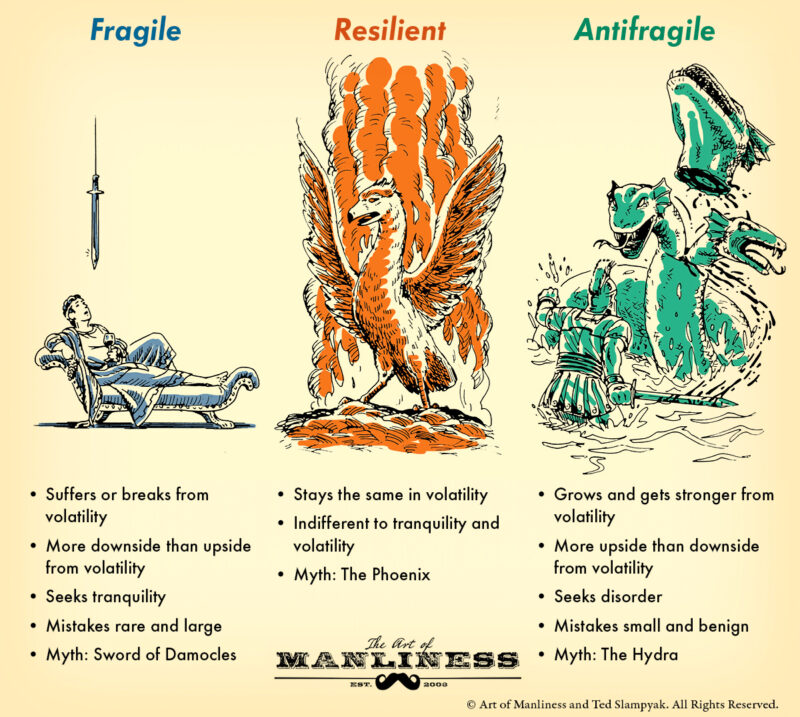
Mine is a conceptual Bank fueled by self-discipline, an Obsession for Money, and a quest for Financial Independence. Since MONEY is Freedom and Security. Two of the most valuable things in life!
PYGOD Bank Goals:
- Wealth Building
- Wealth Preservation
- Financial Independence
- Antifragile.
PYGOD Bank Guidelines:
- Monthly contribution of $1 for each year of your age, or 10% of your profits, or 50% of expendable income—whichever amount is greater.
- 1% Consumption Tax paid to PYB on every non-business dollar spent.
- Can borrow up to 90% of The Vault at 5% interest. You must continue to contribute while paying back your loan monthly.
- Your loan(s) must not be more than what you make in 3 months.
- Never touch the principal ($PYFC 2.0).
- Rules can be amended.
PYGOD Bank has five parts:
- $PYFC 2.0 — The Perfect Investment Vehicle
- BBND Fund — Margin Fund; margin loan ≤ 25% of collateral account(s)
- The Vault — Savings & Loans; 6–24 months of living expenses
- Freedom Fund — Dividend Reserve Fund (DRF)
- MONEY Bin — Start Over Fund; 1–2 years of living expenses
PYGOD Bank can have multiple accounts just like a bank has multiple branches.
TITHE TO YOURSELF
- Monthly contribution of $1 for each year of your age (great for children), 10% of all Receipts, or 50% of expendable income (remaining after living expenses)—whichever amount is greater.
- Receipts include all new money earned or received from outside PYGOD Bank: business net profits, employment income, service income, gifts, inheritances, bonuses, government benefits, and other cash windfalls.
- Receipts include proceeds from the sale of personal property when those proceeds represent capital being freed for discretionary use. Proceeds required to replace an essential asset, such as a primary residence or vehicle, are excluded.
- PYB-generated interest, dividends, and investment returns are excluded. They already belong to the Bank.
- Transfers between your own accounts, loans received, and proceeds from selling existing assets are not Receipts.
- 1% Consumption Tax paid to PYB on every non-business dollar spent.
- PYB dividends are not themselves subject to the tithe; they may simply be used to satisfy it.
- You can tithe in advance.
- You shall always tithe/contribute. Being in debt does not suspend the obligation.
BORROWING FROM YOURSELF
The Vault (Emergency Corpus)
Goal: Maintain 6 to 24 months of living expenses available for borrowing if necessary. 12 months is the goal, but don’t stop until you hit at least 6.

- 12 Months of Expense invested in TCSH.TO, a high-interest (⁓3%) cash ETF.
20% Gold (PHYS) of the remaining balance once the 12-month base is secured.- 80-100% Equity (VFV.TO) of the remaining balance once the 12-month base is secured.
Into a TFSA (CELI) tax-free account, if possible.
- Only use it in absolute necessity.
- Can borrow up to 90% of The Vault at 5% interest. You must continue to contribute while paying back your loan monthly.
- Your loan(s) must not be more than what you make in 3 months.
- Rules can be amended.
5% year interest (compound daily) = Monthly Interest: 0.4166666%/month (x 0.0041666)
Calculated Monthly on the Last Day of the Month
Compound Daily (365) 5%/365 = 0.0136986% (x 0.0001369)
Weekly: 0.0961538% (0.000961538)
Minimum Monthly Payment
2% of the balance or $50 if the 2% of the total amount you owe is less than $50.
Payable on the first of each month.
BBND Fund (Buy Borrow Never Die Fund)
In other words, a margin account.
An income engine financed by borrowed Money with the well-established $PYFC 2.0 as collateral.
Margin Rules
- Maximum target margin usage: 25%.
- Temporary increases up to 30% are permitted only if caused by market declines—not by additional borrowing.
- Collateral must consist exclusively of long-term “forever” investment accounts. Personal accounts, emergency funds, and The Vault must never be pledged as collateral. Current collateral: $PYFC 2.0 (ledger-held cryptocurrency excluded).
- Do not invest new capital directly into the BBND Fund. The fund exists solely to borrow against the collateral account. All new investments belong in the collateral account, strengthening both net worth and future borrowing capacity.
- Investment income should pay the carrying costs. Whenever possible, distributions, dividends, or other investment income generated by the BBND Fund should be used to pay margin interest before any excess income is reinvested.
Philosophy
The BBND Fund is conceptually similar to taking out a second mortgage on a house—except the collateral is a diversified investment portfolio instead of real estate.
The objective is not to sell long-term assets, but to unlock a portion of their value while allowing them to remain invested and continue compounding.
Conservative leverage is the foundation of the strategy. By maintaining a target margin usage of 25%, with a temporary tolerance of 30% due solely to market declines, the probability of forced liquidation is significantly reduced while preserving access to long-term liquidity.
Selection Criteria
First: High and reliable distributions (yield or dividends) to pay the margin interest.
Second: Strong long-term total return (including capital appreciation, dividends/distributions, and stock splits) to grow the borrowed capital over time.
The ideal investment generates enough cash flow to service the debt while continuing to compound wealth over time.
DIVIDEND (The 3% Rule)
Freedom Fund (Dividend Reserve Fund, DRF)
- PYB distributes 0.25% of its market value each month, equivalent to a 3% annualized distribution rate.
- The distribution is calculated using PYB’s total market value at the time of each monthly calculation.
- The distribution is paid exclusively from The Vault.
- $PYFC 2.0 is the Bank’s permanent principal and shall remain untouched.
- The monthly dividend should ordinarily be transferred from The Vault to the Freedom Fund.
- The dividend should ideally remain untouched in the Freedom Fund, where it may be reinvested and accumulated for future use.
- Money in the Freedom Fund may be used for living expenses only when needed.
- The monthly tithe/contribution should ordinarily be paid with the owner’s own money, not with the PYB dividend.
- When necessary, however, all or part of the monthly dividend may be retained within PYB and credited toward the required tithe/contribution instead of being transferred to the Freedom Fund.
- The long-term objective is for PYB to become large enough that its 3% annualized distribution can fully cover the owner’s living expenses without depleting the Bank’s permanent principal.
END GOAL
Live off the 3% yearly dividend and never have to worry about Money ever again. 😎
PYGOD BANK BALANCE SHEET:
ASSETS
- $PYFC 2.0
- The Vault
- BBND Fund (margin account)
- Loans to PYGOD
- Dividend Reserve Fund (DRF)
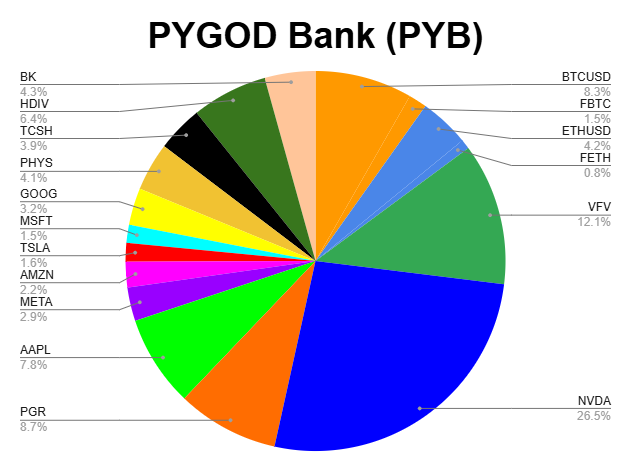
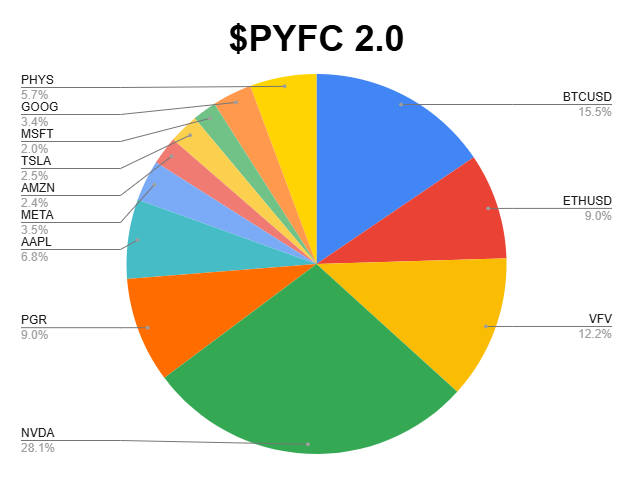
≤ 5% is a little ≥ 15% is a lot
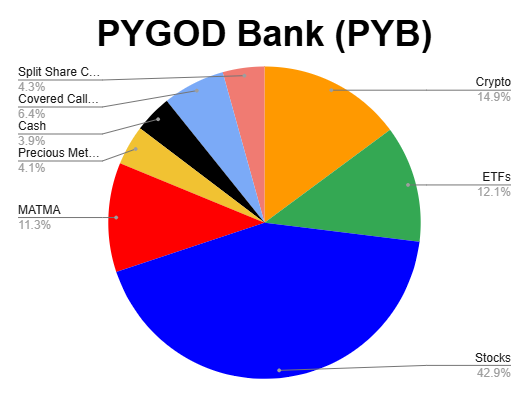
Updated July 27, 2026.
The strength of PYGOD Bank comes from $PYFC 2.0 — a powerful growth engine accounting for 80% of the PYGOD Bank’s capital.

$PYFC (PYGOD Freedom Conglomerate)
PYGOD, Investor/SCA at $PYFC
(Supreme Capital Allocator)
pygod@pygear.com
PYFC.ca
A Foundation, a Collection, a Sovereign Wealth Fund, a Conglomerate, a Currency, and ‘The Secret’ all mixed into one.
One Vehicule: Stock Market (cryptocurrency was an “happy accident” that turned $PYFC into $PYFC 2.0)
Only a few stocks. Only the best.
Only one formula:

Punch Card x Coffee Can
20 Punch Card Portfolio:
“I always tell students in business school they’d be better off when they got out of business school to have a punch card with 20 punches on it. And every time they made an investment decision, they used up one of their punches, because they aren’t going to get 20 great ideas in their lifetime. They’re going to get five or three or seven, and you can get rich off five or three or seven. But what you can’t get rich doing is trying to get one every day.” – Warren Buffett
You have 20 slots (1 investment per slot) for the rest of your life. Choose wisely and carefully.
“The Coffee Can Portfolio harkens back to the Old West, when people put their valuable possessions in a coffee can and kept it under the mattress. The coffee can involved no transaction costs, administration costs, or any other costs. The success of the program depended entirely on the wisdom and foresight used to select the objects to be placed in the coffee can to begin with.” – Robert G. Kirby
In other words, you buy stocks with an investment horizon of at least 10 years and you never sell no matter what. Forget every conventional “wisdom” about diversification and overexposure to a given company or industry. Don’t ever try to time the market. Just HODL (Hold On for Dear Life). The portfolio is not optmized for short-term gains.
Think on a 10-, 20-, and 50-year horizon.
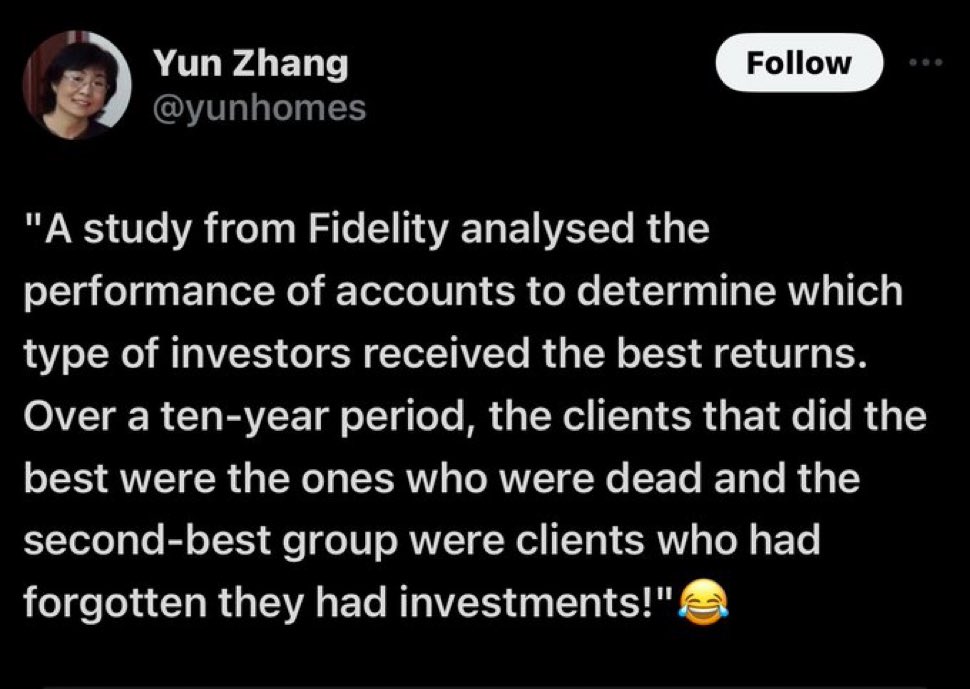

3 measuring sticks:
- AUM (Asset Under Management)
- IC (Invested Capital)
- ROI (Return On Investment)
Goals:
- Capital preservation.
- Long term growth.
6 Pillars:
- PGR
- NVDA (Formerly the “N” in MATMAN)
- AAPL
- VFV.TO
- MATMA
N(META, AMZN, TSLA, MSFT, GOOG) ecosystem “ETF” - PHYS.TO
2 “Happy Accidents”:
- BTC
- ETH
Not a part of $PYFC 2.0
The perfect vehicule to park cash in The Vault
- TCSH.TO
The perfect vehicule for the BBND Fund (margin account).
- HDIV.TO
- BK.TO
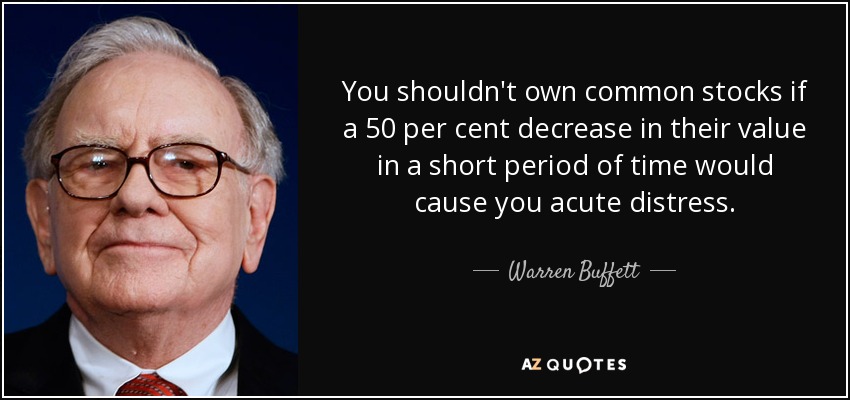
Each stock is bought as a share in a business (as it is).

PGR (Progressive Insurance) The very best, used to be the backbone of $PYFC 2.0.

NVDA (Nvidia) Certainly the leader of the pack in the AI boom since NVDA is selling the pickaxes and shovels.

AAPL (Apple Computer) Enough said!
It’s probably the best business I know in the world.
— Warren Buffett about Apple

MATMAN (META, AMZN, TSLA, MSFT, GOOG) ecosystem “ETF” that I’ve created. 5 of The Magnificent 7, the two other NVDA and AAPL are just above. Since none of them were and are a particular favorite of mine. But as a unit, they make a lot of sense. NVDA was an official member (MATMAN at the time) before flying solo and becoming my new darling. One thing for sure, tech will always goes up on the long term.

VFV.TO (Vanguard S&P 500 Index ETF – Canadian version) Forget about gold, bonds, and real estate. Historically, the S&P 500 (American economy) has outperformed any other assets. My default investment.
Now you own a piece of the 500 largest publicly traded companies in the United States of America and every fucking stiff from the factory floor to the CEO is working to make you richer.
— The Position Of Fuck You by JL Collins

PHYS (Sprott Physical Gold Trust) Buying physical gold without the hefty premiums to pay on buying and selling it. The best of both worlds!
After selling some of my gold jewelry, I’ve changed my mind about gold as an investment. All I can tell you is that my bling-bling — despite the high premiums on buying and selling jewelry — ended up being one of my best investments, decades later.
I see Gold as a default investment just like VFV (S&P 500 Index ETF). A safe investment to fall back on when/if the AI bubble bursts and some of the Magnificent 7 companies get disrupted.
Money isn’t everything – gold is. Fuck T-bills! Fuck blue chip stocks! Fuck junk bonds! We’ve got the real deal! Money will always be paper, but gold will always be GOLD!
— Darwin Mayflower in Hudson Hawk (1991)
Here’s my two illegitimate bastards below. “Happy accidents” is what I like to call them. I see both as nothing more than glorified lottery tickets. But I like them anyway! Maybe they will be of some use one day.

BTC (Bitcoin) The undisputed King of cryptocurrency.

ETH (Ethereum) The distant number 2.
However, ETH can be staked for up to 2.7% APY (Annual Percentage Yield).
Apart from those two, I consider the rest to be worthless shitcoins used for gambling purposes only.
BBND Fund
HDIV.TO – Hamilton Enhanced Canadian Covered Call ETF
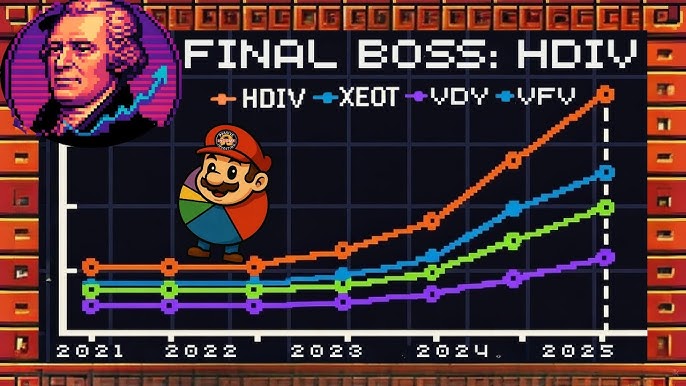
Likely the best vehicle for Canadian investors to invest on margin while letting the monthly distribution yield pay for the margin interest.
HDIV: The GREATEST Canadian ETF of ALL TIME? Growth Investors will be SHOCKED!
BK.TO – Canadian Banc Corp
Fits my two criteria for the BBND Fund perfectly.
First: A high monthly distribution targeting 15% annually, enough to cover the margin interest.
Second: Excellent long-term total return.
Proven through the 2008 Financial Crisis and the 2020 COVID-19 crash.
Invests exclusively in Canada’s Big Six banks:
- Toronto-Dominion Bank
- Royal Bank of Canada
- Bank of Montreal
- Canadian Imperial Bank of Commerce
- Bank of Nova Scotia
- National Bank of Canada
The Vault (Emergency Corpus)

TCSH.TO – TD Cash Management ETF
Following extensive research and analysis — as with everything on this list — TCSH is the best way to park cash in The Vault. Cash that remains available for personal loans when needed. With a safe ≈ 3% yield, TCSH has already beaten every alternative.
Americans have much better alternatives. But in Canada, this is about as good as it gets once you factor in the exchange rate.
You get up two and a half million dollars, any asshole in the world knows what to do: you get a house with a 25 year roof, an indestructible Jap-economy shitbox, you put the rest into the system at three to five percent to pay your taxes and that’s your base, get me? That’s your fortress of fucking solitude.
— Jim Bennett in The Gambler (2014)I ask wealthy people one simple question:Do you have $5 million liquid? You’d be shocked how many say no.They own assets — homes, watches, businesses — but no cash and when things go wrong… none of that matters.Liquidity is survival.I keep $5 million in T-bills for one reason:Peace of mind.Because when chaos hits, I don’t panic — I open my account.
— Kevin O’Leary
Asset Class: Private Debt
Vehicle: Loans to the Founder
Return: 5% annual interest
Purpose: Emergency financing
The purpose of The Vault, PYB’s emergency corpus, is to provide loans to its owner when necessary. Money borrowed from The Vault is not a withdrawal from PYGOD Bank. It is a loan that must be repaid with interest.
From the Bank’s perspective, the loan is an investment asset. Cash is exchanged for a receivable that earns a 5% annual return until repaid.
Loans shall be repaid with a Minimum Monthly Payment of 2% of the outstanding balance, or $50 if 2% of the outstanding balance is less than $50. Payments are due on the first of each month.
Example
$10,000 loan × 5% = $500 annual interest
The outstanding principal remains recorded under Loans to Me as an asset of the Bank until repayment.
≤ 5% is a little ≥ 15% is a lot
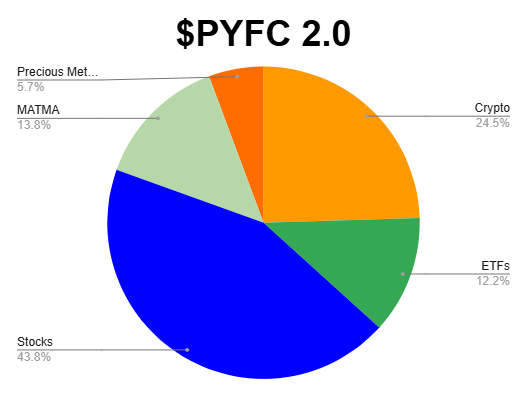
Updated January 5, 2026, with the completion of $PYFC 2.0
$PYFC 2.0
Fund Managed: 1
Founded: March 16, 2022 (Bitcoin); June 3, 2022 (Stock Market).
Investing Assets: Stocks, ETFs, Cryptos, Precious Metals
Investment Style: DCA x HODL/CONCENTRATION = $PYFC
Sector: Equity (Long)
Geography: United States
Time: Forever
Investment Stage: Late (Mature Companies)
Strategy: DCA x HODL/CONCENTRATION = $PYFC
# of Holdings: 11
The very best investment vehicule ever created. So great, it’s should be its own currency!
I’ve created it!
Now that you know The Secret, a well-deserved donation to $PYFC 2.0 would be more than appreciate.
MONEY Bin
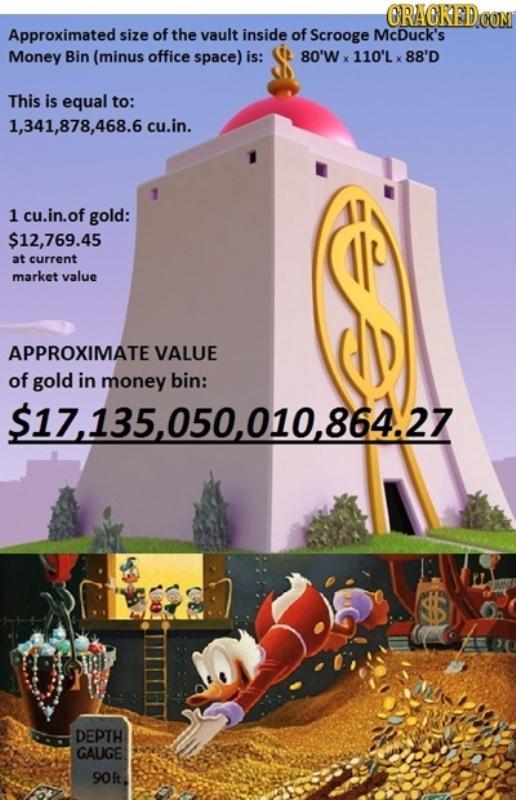
Start Over Fund — 1–2 Years of Living Expenses
The MONEY Bin is the final layer of PYGOD Bank.
It is funded only after the Bank’s more immediate capital requirements—particularly The Vault—have been satisfied. Reaching the MONEY Bin stage means the core financial system has already been successfully built.
The MONEY Bin is not an emergency fund. It is not working capital. It is not available for investments, ordinary financial hardship, or opportunities.
It is the ultimate reserve: enough independently held wealth to start over from scratch if everything else fails.
The target is 1 to 2 years of living expenses, held primarily in self-custodied Bitcoin, protected by an additional passphrase (“25th word”), for its portability, global liquidity, scarcity, and independence from traditional financial institutions. The trade-off is extreme volatility: Bitcoin can lose 50% or more of its value during major market downturns.
Treat it like a Treasure.
You should never touch it.
Except in case of a zombie apocalypse.
PYDRE produces income → PYB takes its contribution.
PYB produces a dividend → PYB takes a contribution from its own dividend.
Capital compounds inside PYB → $PYGOD Net Worth grows.
Even when PYB lends money to its owner → the loan earns 5% interest for PYB.
The Bank can pay you, lend to you, or receive from you, but capital is structurally encouraged to flow back toward the Bank.
Now, all you got to do is to fund it.
Feed the Bank!!!

Everything of the above, just like anything worthwhile in life, is only possible with one thing.
DISCIPLINE
The Bank Always Wins
PYGOD, Banker of PYGOD Bank
References:
Family Bank – Start One In 5 Simple Steps
https://www.linkedin.com/pulse/you-can-illuminati-following-three-steps-sudarsan-babu/
https://funcheaporfree.com/the-7-bank-accounts-your-family-should-have-updated/
https://jaserodley.com/why-you-need-a-freedom-fund/
https://www.quantumamc.com/asset-allocation
https://paradigmlife.net/personal-family-banking-system/
https://paradigmlife.net/understanding-the-wealth-maximization-account/
https://pitchbook.com/blog/what-is-a-fund-family
https://www.sentex.ca/~ggrevs/LearnToTitheToYourself.html
https://humbledollar.com/2017/10/self-tithing/
https://rossdawson.com/power-of-giving-away-profits/
https://petikspinayinvestor.wordpress.com/wp-content/uploads/2015/05/the-money-jars-edition-3.pdf
https://www.everydaycheapskate.com/how-to-be-your-own-lender/
https://www.rouletlaw.com/library/the-family-bank-strategy-that-keeps-wealth-in-your-bloodline.cfm
Rich Families Use This | The Family Bank Strategy
https://wisestacker.com/family-bank-5-tips-secure-financial-future/
https://www.peoplespolicyproject.org/projects/social-wealth-fund/
https://levelthefield.substack.com/p/creating-a-sovereign-wealth-fund
https://www.ubiworks.ca/gbi-vs-ubi
Trust Fund Baby How to ($300 per month)
https://sabercapitalmgt.com/practicing-a-punch-card-approach-to-investing/
https://brontecapital.blogspot.com/2016/09/comments-on-investment-philosophy-part.html
https://tdmgrowthpartners.com/insight/punch-card-mentality/
https://kestrel.ie/resource/practicing-a-punch-card-approach-to-investing/
https://sabercapitalmgt.com/the-coffee-can-edge/
https://novelinvestor.com/the-coffee-can-approach/
https://www.intelligentinvestor.com.au/investment-news/till-death-do-us-part-my-never-sell-list/139202
Why I Only Build on the S&P 500 (Not VTI, QQQ, or the Dow)
HDIV: The GREATEST Canadian ETF of ALL TIME? Growth Investors will be SHOCKED!
Why Oligarch’s Love Their Mega Yachts
Disclosures:
I am long BTC, ETH, NVDA, PGR, VFV, AAPL, META, GOOG, MSFT, AMZN, TSLA, PHYS, TCSH, HDIV, and BK.
The content contained in this whitepaper represents the opinions of PYGOD. You should assume PYGOD and his affiliates have positions in the securities discussed in this whitepaper, and such beneficial ownership can create a conflict of interest regarding the objectivity of this whitepaper. Statements and figures in the whitepaper are based on historical data and do not guarantee future performance. Investments in stocks, stock indices, cryptocurrencies and commodities can be volatile and are subject to certain risks, uncertainties and other factors. Certain information in this whitepaper concerning economic trends and performance is based on or derived from information provided by third-party sources. PYGOD does not guarantee the accuracy of such information and has not independently verified the accuracy or completeness of such information or the assumptions on which such information is based. Such information may change after it is posted and PYGOD is not obligated to, and may not, update it. The commentary in this whitepaper in no way constitutes a solicitation of business, an offer of a security or a solicitation to purchase a security, or investment advice. In fact, it should not be relied upon in making investment decisions, ever. It is intended solely for the entertainment of the reader, and the author. In particular this whitepaper is not directed for investment purposes.
Financial Flywheel

LEVERAGE is the ultimate goal, and to get there you need enough momentum to get the financial flywheel spinning.
Your business (PYDRE) make money then you put the money in the middle (PYGOD Bank) to make more money.
Profits are reinvested, increasing the amount of capital working on my behalf and building momentum with every turn of the wheel.
PYDRE → Profit → PYGOD Bank → More Money → More Capital → Repeat.
Or, even simpler:
1. Get Money.
2. Acquire and hold stocks.
3. Repeat.
Making MONEY. Having MONEY. Keeping MONEY.
PYGOD, King of GODistan, CFMI of $PYGOD, Founder CEO of PYGear.com, Banker of PYGOD Bank
Originally published: August 28, 2026
Last updated: September 8, 2026
This is a living document and may evolve over time.
Circa 1808: John Jacob Astor (born July 17, 1763) becomes the world’s first millionaire.
Circa 1916: John D. Rockefeller (born July 8, 1839) becomes the world’s first billionaire.
June 2026: Elon Musk (born June 28, 1971) becomes the world’s first trillionaire.